
Work and Play: 20 Years of the Mazda BT-50
Work and Play: 20 Years of the Mazda BT-50
From Three Wheels to Workhorse: Mazda's Ute Origins
Positioned to your right as you enter Mazda Australia’s Mulgrave headquarters is the tiny T600 from 1960, the first vehicle the company offered in Australia.
A diminutive three-wheeled pick-up, it’s transport stripped to its bare essentials: a bench seat, windscreen, tray and little else. Behind the occupants sits a 577cc air-cooled V2 engine, which would’ve needed every one of its 15kW/37Nm to deal with the 500kg maximum payload.
Indeed, the framed advertisement in the back boasts that the T600 is “almost as economical as walking...but so much easier – so much faster”. The same picture also says “The first of many”, which it certainly was.
Since its very inception, commercial vehicles have been integral to the Mazda brand, the T600 being a significant evolution of the Mazda-go Type-DA three-wheeled pick-up truck that first entered production in 1931.
By the time the T600 appeared, Mazda was on the cusp of a revolution. In August 1961 it introduced the B1500 compact ute, the first iteration of the ‘B-Series’ that would toil all over the world for 55 years and five generations.

2006: The BT-50 Is Born
The "B-Series Truck" Heritage
In 2006, the Mazda ute entered a new era with the reveal of the BT-50 at the Bangkok International Motor Show, the name bringing it into line with Mazda’s global alphanumeric nomenclature strategy.
According to Malcolm Gough, Executive Officer and general manager of Mazda’s Overseas Sales Division (and who had previously been Managing Director of Mazda Australia): “BT-50 recognises the new range’s B-Series Truck Heritage (BT) and the number 50 reflects that this one-ton vehicle is optimally positioned between smaller payload trucks (eg half-ton) and much larger trucks.
“BT-50 builds on a tradition of Mazda heritage and values. Its aggressive presence, command of the road and powerful new turbodiesel engines will provide leadership in this competitive truck segment.”
The BT-50 launched as the ute was undergoing a metamorphosis, transforming from a tool of the trade to a jack of all trades. This evolution can be clearly traced during the BT-50's 20-year lifespan, both in its specification and the range of variants on offer.
Sales figures tell the story. In 2006, the year of the BT-50's introduction, utes made up 14.4 per cent of the market, but 4x4s were just seven per cent. Fast forward to 2025 and while overall ute share had increased to 20.2 per cent, 4x4s now accounted for a whopping 17.6 per cent.

The SDX Experiment: Would Buyers Pay for Comfort?
However, 20 years ago utes were still primarily bought for work and the BT-50 launched with the option of a 4x2 or 4x4 in single-cab, Freestyle extra-cab and dual-guises. The DX opened the range, available in all bodystyles, while the SDX could only be had as a 4x4 extra- or dual-cab. It’s a sign of how things have changed that only the dual-cab SDX could be had with an automatic gearbox.
Compared to the Bravo that preceded it, the BT-50 was a big step up mechanically. The 4x2 used a 2.5-litre four-cylinder turbodiesel that increased outputs from 82kW/271Nm to 105kW/330Nm, while claimed fuel consumption dropped from 9.7L/100km to 8.3L/100km.
A larger 3.0-litre four-cylinder turbodiesel was used in the 4x4 producing 115kW/380Nm, while the 9.2L/100km fuel consumption was described as “outstanding” by one reviewer, and the maximum braked towing capacity increased to 2500kg from the Bravo’s 1800kg.
The DX single-cab chassis opened the range at $23,255 plus on-road costs, though an introductory offer included air-con and a tray for $20,990. Bargain. Front airbags and front seatbelt pretensioners were standard across the range, though ABS was still optional apart from on the SDX where it was standard.
At the time, the SDX was seen as a bit of an experiment – would buyers pay extra for passenger car luxuries that were traditionally lacking in a dual-cab? Spoiler alert, they sure would.
The SDX featured 16-inch alloy wheels, painted wheelarch extensions, chrome exterior trim and an in-dash six-stacker CD player as well as that standard ABS and the option of a five-speed automatic gearbox, which also included ‘on the fly’ switching between 2H and 4H.

2011: The Ute Grows Up
In 2011 the second-generation BT-50 arrived. By now the trend was clear; in the course of five years 4x4 utes had increased their market share to 9.9 per cent and buyers were increasingly gravitating to more ‘gentrified’ options.
All of a sudden, dual-cab utes were now as likely to do the school run as the tip run and needed to be as safe as they were hardy. The new BT-50 responded accordingly, even visually, its styling forgoing the boxy look of many rivals in favour of a clear resemblance to Mazda’s passenger car range.
Even the entry XT grade now featured remote central locking, cruise control, a six-speaker CD stacker with steering wheel audio controls, USB connectivity, voice-controlled Bluetooth, power windows and mirrors and air-conditioning.
Higher grades added dual-zone climate control, leather upholstery, alloy wheels, auto lights and wipers and satellite navigation, while stability control, trailer sway control, emergency brake assist, anti-roll mitigation and six airbags resulted in a five-star ANCAP safety rating.
But the BT-50 hadn’t forgotten its roots and 50 full-time engineers worked in Australia on the four-year project to ensure Mazda’s new ute was as capable as ever. The smaller 2.2-litre four-cylinder turbodiesel now effectively matched the outputs of its predecessor’s larger 3.0-litre at 110kW/375Nm, while the new 3.2-litre five-cylinder turbodiesel increased this to 147kW/470Nm at no detriment to fuel economy.
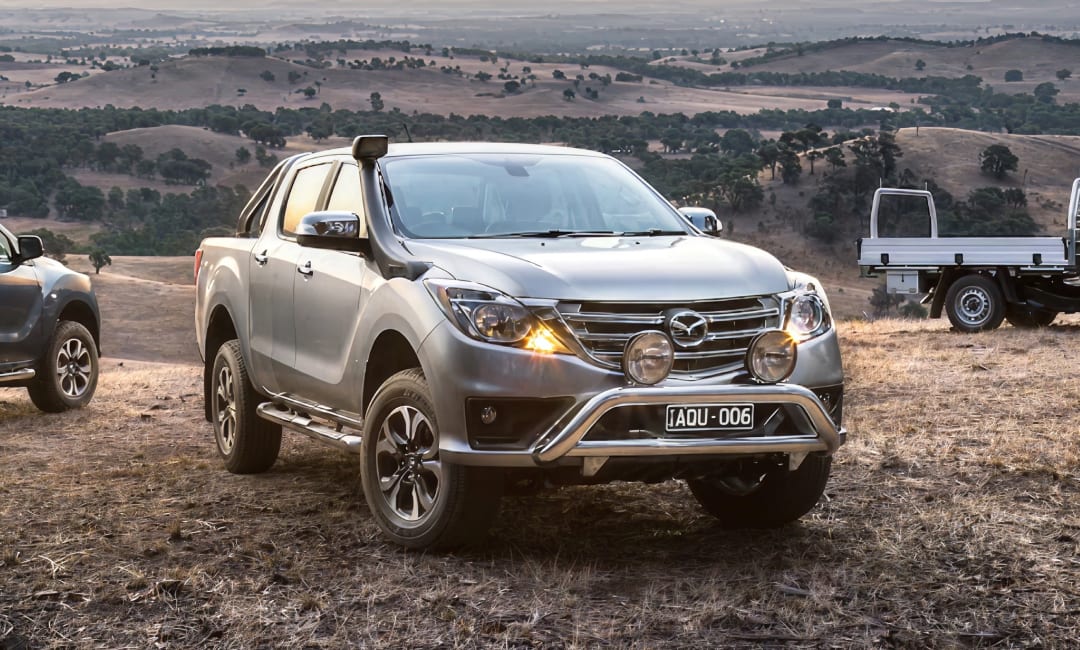
Maximum braked towing capacity increased to 3500kg [Explore Mazda BT-50 Payload Calculator], the stiffness of the ladder-frame chassis was doubled with liquid-filled body mounts to reduce noise and vibration, rack-and-pinion steering was introduced for greater accuracy, switching between 2H and 4H could be done on the move at up to 120km/h and Mazda’s factory-backed accessories range now numbered 105 items, from airbag-compatible bullbars, tonneau covers, sports bars, unique wheel designs, snorkels, auxiliary battery systems and much more.

2015: Kodo Design and a Touchscreen Arrive
In 2015 the BT-50 adopted Mazda’s latest Kodo design language with XTR and GT variants also gaining a 7.8-inch touchscreen infotainment display, but the BT-50 hadn’t forgotten its workhorse roots, with the XT single-cab chassis 4x2 still priced at just $25,570 plus on-road costs, while 4x4 variants boasted 237mm of ground clearance and a wading depth of 800mm.

2020: A New Partnership and a Safety Leap
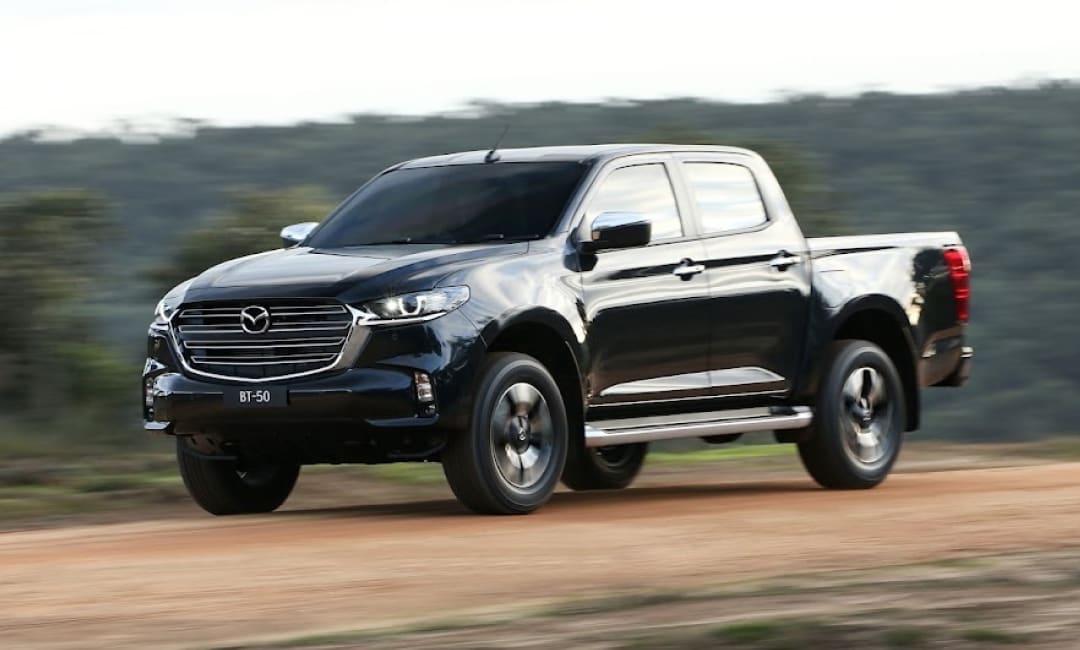
The third-generation BT-50 arrived in late-2020 and while the visible product was a clear evolution of its predecessors, under the skin there was monumental change. Since 1972 Mazda had enjoyed a technical partnership with Ford, sharing resources on the B-Series/Courier and then BT-50/Ranger, but the latest BT-50 would be twinned with the Isuzu D-Max, a relationship that continues to the present day.
One of the biggest improvements with the move to the new generation was safety. By now many Australians were using dual-cabs as de facto family cars and the new BT-50 ensured its reputation for five-star safety continued.

Eight airbags, including a front-centre airbag to prevent occupants colliding in a side impact, were joined by autonomous emergency braking, attention assist, auto high beam, blind-spot monitoring, emergency lane-keeping, lane-departure warning and prevention, rear cross-traffic alert and speed assist.
A larger 9.0-inch infotainment screen introduced wireless Apple CarPlay and digital radio along with wired Android Auto, while heated seats appeared on higher-spec variants. Electrically assisted steering also further reduced driving effort, especially in low-speed manoeuvering whether that be urban or off-road.

2026: The BT-50 Today - Then vs Now
Comparing the specifications of the first BT-50 with today’s illustrates the gains that have been made. Whereas the original 2.5-litre four-cylinder turbodiesel produced 105kW330Nm with fuel consumption of 8.3L/100km, the smaller 2.2 now manages 120kW/400Nm while consuming just 6.9L/100km. Explore BT-50 full specifications.
It’s a similar story for the 4x4. The original 3.0-litre engine boasted 115kW/380Nm and 9.2L/100km – a figure described as “outstanding” remember? – while the latest 3.0-litre offers 140kW/450Nm and 8.0L/100km.

When it comes to pricing, the original DX 4x2’s $23,255 looks remarkable value, but in today’s money that equates to $38,000, whereas the 2026 BT-50 range opens at $38,400 plus on-road costs, despite vast improvements in efficiency, comfort and safety.
Today’s BT-50 offering has expanded to 20 variants with something for every buyer and budget, whether it be the entry-level XS 4x2 single-cab chassis, the value-focused Boss 4x4 dual-cab, rugged GT SP or adventure-ready Thunder with its locally developed accessories.
If it had feelings, no doubt the T600 has a sense of pride at what it began more than 65 years ago as it looks through the window at its successors. It was, indeed, the first of many.